Dyman Gallery | Investment Art | Art Valuations Logo

Pierneef’s Wanderings

As the First World War arrived on European shores, Pierneef was revelling in the applause his works were receiving. After his first solo exhibition in 1911 where many exalted him as a genius, his second solo exhibition included most of his new work as well as some graphic works. These too received favourable coverage. The artist started spending more and more time researching South African Art and its influences, becoming an authority on the subject.

Post-Boer war South Africa left Afrikaners with a sense of bitterness towards the British, resulting in a strong sense of nationalism amongst the Afrikaners. Enter Jacobus Hendrik Pierneef.

J.H Pierneef

This was the perfect setting for Pierneef to familiarise himself with the Afrikaner’s way and sided with their culture and art. He went on to illustrate many books written by well-known South African authors and advocated for Afrikaans as an official language. During this time he continued working at the state library, only starting a career in education in 1918. The first position he held was the the Heidelberg College of Education and then later at the Pretoria College of Education.

The time he spent in the then South African Education system proved to be very frustrating. Pierneef’s dislike of the English education system forced on colonial South Africa meant that his career as an educator would be short-lived. He was of the opinion that South African artists are unique and should have the freedom to develop their own style. In 1924 he embraced the title of  “professional artist”.

Pierneef’s wanderings proved that not all artists are the same. He would spend many years in public service before focussing on his first love. A journey with many twists and turns, but one that etched him into the history of South African art.

Image Source: invaluable.com

Source Credit: nladesignvisual.wordpress.com and sahistory.org.za


Pierneef: The rise of a Genius

Jacobus Hendrik Pierneef, an esteemed South African artist was the son of a Dutch immigrant, who was a close friend of former president Paul Kruger.  He took his first steps as an artist at the Staats Model School in Pretoria. It was here where one of young Henk’s teachers inspired his love for nature and rock formations.

The outbreak of the Anglo-Boer war forced the Pierneef family back to their homeland as an alternative to imprisonment. The family settled in Hilversum where Henk and his sister could receive needed medical treatment. The former started working at a paint factory in his spare time, a good place to learn the intricacies of mixing paint. Over time he involved himself in various other activities such as night classes where he learnt about architectural drawing and later on at the Rotterdam Art Academy. These experiences accumulated into Pierneef’s growing knowledge of the old Dutch masters.

Pierneef Art

J.H Pierneef returned to Pretoria as a knowledgable young adult, ready to embark on a career in art. He would paint in his studio during the day and work at the state library during the night. This routine continued for almost 10 years. His first public auction was a great success. Collaborating with van Wouw and Naude and attracting interest from various well-known personalities of the time. He found much encouragement from the positive feedback he received from the public. As is often the case, a young man like Pierneef is subtly in search for a soulmate. At the start of 1910 he married Agatha Delen, despite opposition from both families. Pierneef was a young 23 year-old and his new wife a more advanced 35.

Pierneef’s career was now starting to take shape. He subsequently took part in a group exhibition and had two etchings sold. His first solo exhibition in 1913 was a milestone event that announced Pierneef as a master. Some critics labelling him a genius, a source of much inspiration and discipline.

source credit: nladesignvisual.wordpress.com and sahistory.org.za
image credit: en.wikipedia.org

The Travels of Irma Stern

Irma Stern is seen as one of the most important artists to be produced by South Africa. Her work has been celebrated by numerous exhibitions all over the world and has also found a home in many embassies throughout Europe.

Irma Stern Art In 1926 Ms Stern married Johannes Prinz, her earlier mentor, who later became professor of German at UCT. While living in South African with her new husband, Stern would often return to Europe to exhibit in places like Paris, Berlin and Amsterdam. A year later she was recognised at the ‘Bordeaux International Exhibition’ for her efforts and subsequently elected to represent her homeland at the ‘Empire Art Exhibition’ in London a short while later.

Unfortunately their marriage was never a happy one and each went their separate ways in 1934. This was also during the time of political unrest in Europe and especially Germany. Stern used this new phase in her life to explore the many rich cultures of Africa. At times she stayed away for months at a time, undertaking trips to places like Senegal, Zanzibar and Congo. The artist used these trips to explore the land and collect subject matter for some of her paintings. In addition to this she would also go on to publish two books about her travels to Congo and Zanzibar respectively. These paintings often focussed on culture rather than individuals. She used the people whom she came into contact with as subject matter and studied them as a representation of the culture at large.

Her approach was in contrast to many other South African artists of the time. People like Dorothy Kay, Constance Greaves and Joyce McCrea were considered to be realist painters whereas Stern’s approach was different. Her personal style and expressive nature had a significant influence on the subjects of her paintings. Stern was at the peak of her career during the 40s and 50s. She often travelled to Europe during this time, but was still firmly rooted as a South African artist during this time.

Source credit: sahistory.org.za and wikiart.org

Irma Stern’s Fishing Boats in the Cemetry

Irma Stern Art What would Irma Stern’s Fishing Boats do in a cemetery, under a park bench? Some artists have a very unique way of doing things, this was certainly not one of them.

Although her life begin in the obscure little town of Schweitzer-Renecke, her story really began as an art student in Germany. She showed tremendous growth as an artist, first at the Weimar Academy and later under Max Pechstein at Levin-Funcke Studio. Stern found herself in the company of numerous great German expressionists at the time. The artist had a sense of German precision and will to succeed at all cost.  History has it that Stern would often cut herself off from the world by putting up a “do not disturb” sign outside her studio and relied on her cigarettes and strong black coffee to get her through another project.  She would stay there until it was finished and had a personal philosophy of never touching the canvas after she had finished a painting.

She took part in almost one hundred exhibitions across Europe and South Africa. Even though her work had received much acclaim from as early as 1920, it took another decade or two for Stern to found a way into the hearts of her homeland. Upon her return to the republic around 1927, Irma Stern moved into her first house in Rondebosch and stayed there until her death in 1966.

Irma Stern is one of South Africa most accomplished and well-known artists, but not before reviews titled her work as  “Art of Miss Irma Stern – Ugliness as a cult”. Whether the thieves who stole one of her paintings knew this much about her is debatable, fortunately her work was recovered from under a bench in a Port Elizabeth cemetry in 2012.

Erik Laubscher: Painting from the soul

Erik LaubscherPeople marvel at art for various reasons, some for beauty, others for inspiration, but the art of Erik Laubscher had the ability to speak to the heart. One could also argue that he had the ability to capture a moment in nature and bring it to life. As previously stated, art brought him to a deep spiritual place. The same awe that many might find when they look up at a starlit sky or in the middle of an open field.

Laubscher is the first to admit that his paintings are products of his admiration for the forms, elements and atmosphere around him. Some might think that he was a master of composition, when he actually painted those things to which his being was connected. This was a place where emotion gained form and shape and the canvas and palette would often become an arrangement of his perceptions. The thing that struck many is the integrity of his art; what you saw was the outpouring of his soul. Some refer to the strength of the emotion he used and others are impressed by the precise image – trademarks of his meticulous craftsmanship.

Reminiscing on the life Erik Laubscher seems even more remarkable when considering that he started out as an art school reject. In order to support his family he worked as a salesman for Plascon. One could argue that it was when he started the Ruth Prowse Art Centre in Woodstock that his art career would take off again, leading him to the São Paulo and Venice Biennale and also included in major museums, university and public collections.

During his illustrious career spanning 60 years, he represented South Africa at the São Paulo and Venice Biennale and was included in major museums, university and public collections.

A fitting tribute to this well-known South African artist would be that he is counted as one of the most remarkable Cape Town artists of his time.

Photo credit: johansborman.co.za

Erik Laubscher, young talent to leading artist

Erik Laubscher Erik Laubscher is a South African artist who spent the best part of 60 years exploring, taking in and portraying South Africa’s landscapes. He particularly admired the Overberg and Swartland regions. These landscapes presented him with more than just a smell or a memory, these experiences represented some kind of spiritual significance. Over the last few decades Laubscher took keen interest in capturing the detail and depth of the sceneries he composed. He managed to combine lines, forms, colours and textures into a well-structured piece of art. Laubscher succeeded to invite one into his art, celebrating the intricate beauty of the land.
Walter Battiss, a member of the New Group, praised Laubscher’s ability to paint big canvases with satisfying assurance. He also praised the artist’s ability to bring something fresh to the stale ideas in the Cape. (as noted by creativefeel.co.za) After returning to his homeland, it took Laubscher some time to adjust; eventually shifting from Parisian-styled art to South African landscapes. It all started when Laubscher travelled to a small Eastern Cape coastal town, called Kenton-on-Sea. This town is situated along one of South Africa’s most pristine coastal areas. The most likely place for anyone to indulge in the beauty of nature.

Laubscher was a well-repsected artist among his peers, approaching landscapes with the eye of a photographer. Travelling around the Western Cape he was often reliant on luck, in order to be in a certain place at certain time to capture an image which would last only a few seconds. He regarded his art as a privilege, recreating landscapes or showcasing an array of moods through his experience.

Erik Laubscher Art If you pay careful attention to Erik Laubscher’s career you might notice a golden string of greatness running throughout. As a youngster he was recognised as a promising young experimental artists and by the 60’s he was one of the country’s leading abstract painters. He managed to create a unique identity when it would have been easier to fit the mould.

(photo credit: www.carmelart.co.za and www.johansborman.co.za)

Erik Laubscher’s Ladder to Success

Erik Laubscher Erik Laubscher is a South African artist with a unique story. In the words of the German writer and statesman Jonathan Goethe, one sees a picture of the life of an artist:  “There is no safer way of avoiding the world than through art, and there is no safer way of being linked with the world than through art.” Laubscher was a man with “bold views and colours, a born teacher and a ‘hands-on’ personality.” (Fiona Chisolm, IOL news )

Laubscher made the move to the then world superpower, Great Britain and spent short bursts of time at very reputable instiutions and with numerous well-known artists of the time. Some of his time included portrait drawing with Frank Slater and studies at the Anglo-French Art Centre with John Berger. He also shared lodging with fellow artist Breon O’Casey. In 1950 he chose Paris as his home – mainly to further his education. He immersed himself in cubism, a visual art style of the 20th century, under the guidance of Fernand Léger, one of Académie Montmartre’s most well-known teachers. This time in his life had obvious effects in the kind of artist Laubscher would become.

Erik Laubscher Art

His art speaks of a certain type of boldness and emotional engagement – something which became more evident as his career progressed. He was often marvelled by and experienced some kind of emotional attachment when coming into contact with landscapes. He was fond of using his art as a way of communicating those deep seated emotions. Erik Laubscher is credited with “blending” abstract art into the local art scene.

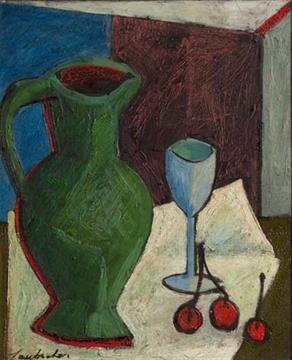
Upon his return to South Africa Laubscher almost immediately became part of the so-called New Group of painters, a place where his fingerprint on South African art would start. His involvement in South African art culminated in the sale of his oil painting Still Life with mandolin, music score and fruit for a record breaking R 1.2 million.

(Image credit: WWW.ROSEKORBERART.COM and WWW.THE-SALEROOM.COM)


Erik Laubscher makes his mark

Here is a typical Walt Disney story of rejection being the springboard to later success. Erik Laubscher is one such example. As he attempted to enrol himself for further studies in art he was rejected, with the words “you can’t draw to save your life”. His next stop was the well-known Belgian artist, Maurice van Essche, new art school. As they say, “the rest is history.”

Best known as Erik, Frederik Bester Howard Laubscher was born on 3 February 1927 in Tulbagh, in the Cape. Attending Pinelands Junior School, Laubscher developed an interest in art during the 40s, almost the same time at which Maurice van Essche moved to Cape Town. After being rejected by the highly esteemed Michaelis School of Fine Art, he coincidentally met up with van Essche for private art lessons.

Erik Laubscher Absolut Art

It was on his mentor’s recommendation that he went to study in London and set foot on English soil just after the end of World War II. During this time he learnt from people like Frank Slater and Fernand Léger. The latter having a decisive influence on his work as an artist. Laubscher briefly returned home to enjoy some home-made cooking, but in 1950 he moved to Paris to further his studies at the Académie Montmartre.  This move changed his life in more ways than one. He fell in love with Claude Bouscharainm at the Academie Montmartre. The couple got married in Cape Town a short while later in his home country.

He had now come a long way since being rejected by Michaelis and the years that lay ahead would set the stage for a very successful career of art.

Robert “Gwelo” Goodman’s Best Years

You get artists and then you get artists. This kind of comparison is often used to distinguish the ordinary from the sublime, peculiar or even extraordinary. While Goodman might not have had an eccentric personality like Alexis Preller, some of his works certainly set him apart from the ordinary.

Robert Gwelo Goodman

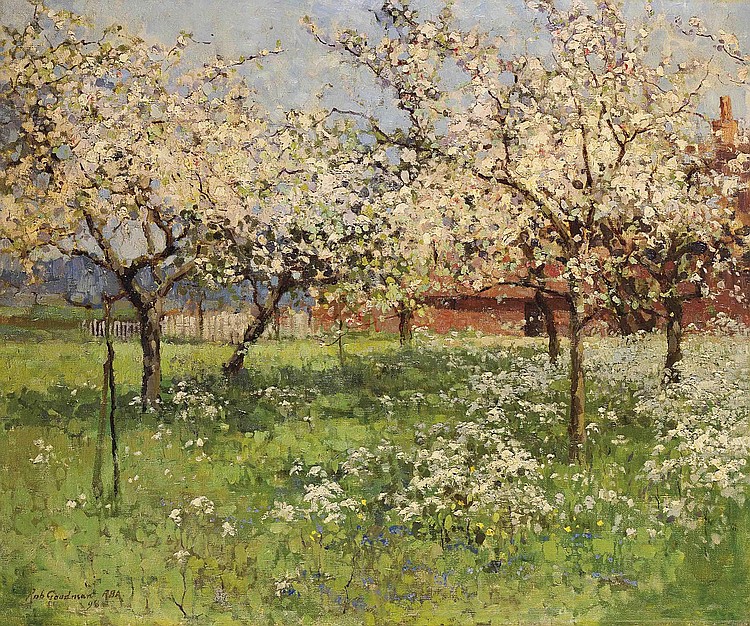
Robert Gwelo Goodman’s roses have been labelled by some observers as “unimaginative and academic”, while other sources conveniently avoid the topic. Flower studies might not have been his speciality, but painting breathtaking landscapes and street scenes were second nature to him.

Following on from his success in landscapes he continued in a similar fashion, now also with interior scenes. The renovation of his home exposed his own knack for architectural adaptation, something he continued with for a large part of his career. Goodman went on to design a house in Johannesburg and community centre in Tongaat, KZN. One of his standout projects being the conversion of an old brewery in Newlands into his home. He renamed it Cannon house, after its original naming of old Cannon Brewery.

These experiences gave him the necessary expertise he would need to collaborate with Dorothea Fairbridge in her book Historic Houses of South Africa. During this time he also mainly focussed his work on Cape Homesteads and old Dutch houses. Three of his works even made the cut to be exhibited at England’s Royal Academy.

His art career continued for much of his life, even up to the lasRobert Gwelo Goodman t months before his death. Goodman was commissioned to do 10 paintings for the South Africa House in London. His final exhibition was held at the Argus Gallery in Cape Town. Many pundits describing this as his only exhibition that failed financially. Robert Gwelo Goodman died at his Cape Town home in 1939, as a result of a stroke.

After his death his works were sold off at his home in Cape Town, affording many collectors and galleries the opportunity to acquire some of his works.


Credit: countrylife.co.za and straussart.co.za

Photo credit: christies.com  and artnet.com